

Los Angeles, skate culture and denim taken to its widest extreme
The History of JNCO Jeans
How a Los Angeles denim label turned enormous leg openings, graffiti graphics and feet-swallowing proportions into one of the defining youth uniforms of the 1990s and early 2000s.
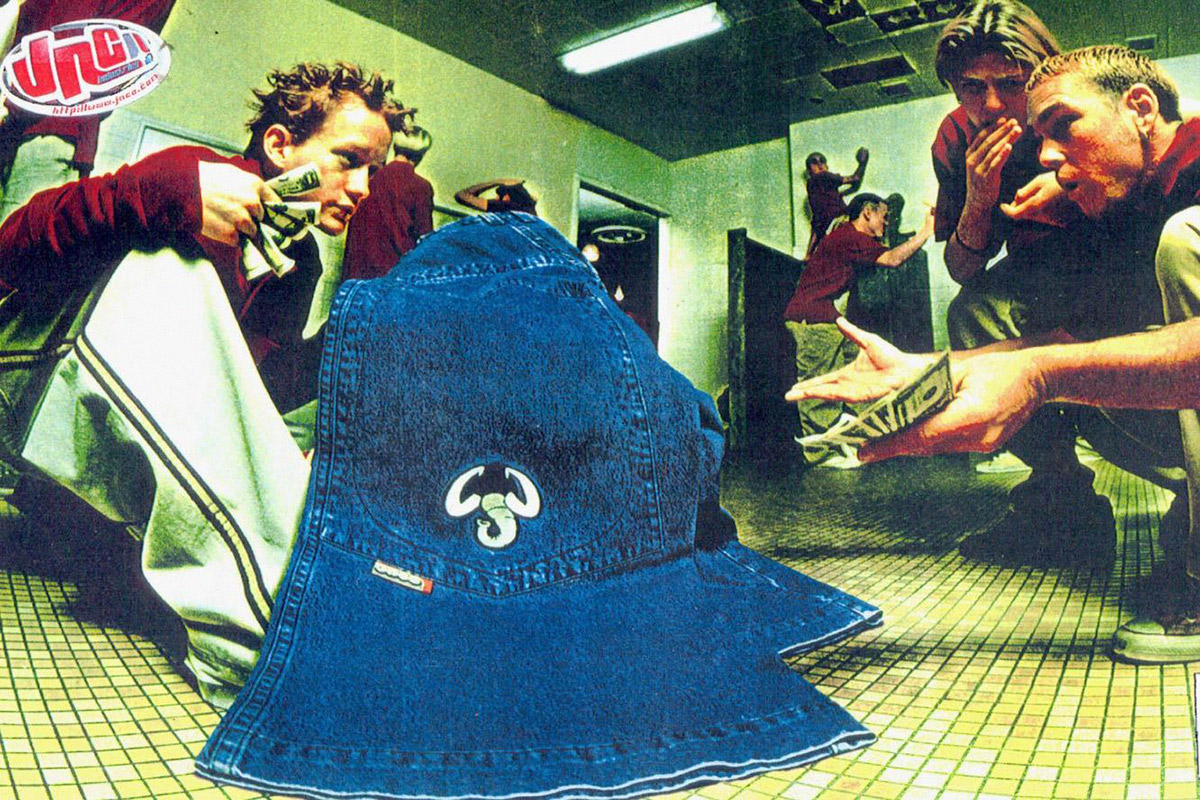
JNCO jeans did not simply join the baggy denim movement. They exaggerated it until the silhouette became impossible to ignore.
At their most recognisable, JNCOs sat low, dropped heavily through the leg and opened wide enough to conceal most of the wearer’s footwear. Huge back pockets, embroidered crowns, cartoon graphics and industrial detailing transformed an everyday pair of jeans into a complete visual identity.
The brand’s rise connected several worlds that were shaping 1990s youth culture: East Los Angeles street style, graffiti, skateboarding, surfing, rave culture, hip-hop, alternative music and the mall. What began as an unconventional denim idea became a mass-market symbol of refusing to dress like the generation before.
Seven chapters tracing how JNCO widened denim, entered youth culture and returned as a vintage icon.
The Context
Before denim became enormous
During the early 1980s, mainstream jeans were still shaped by familiar five-pocket construction and comparatively conventional straight, tapered or bootcut legs. Denim was already central to American clothing, but most established brands built their identity around durability, heritage and recognisable fits.
At street level, silhouettes were changing. Hip-hop culture was making roomier clothing more visible. West Coast youth style drew from workwear, low-riding trousers, sportswear and local neighbourhood dress. Skateboarders also preferred clothes that allowed movement and could survive repeated contact with concrete.
The idea of wearing jeans wider and lower was therefore already present before JNCO became famous. The label’s importance came from taking those existing signals, enlarging them and turning exaggeration into a brand language.
A wider cultural history
JNCO did not invent baggy trousers
Oversized clothing had roots across workwear, hip-hop, Latino style, skateboarding and rave culture. JNCO’s contribution was to make extreme width commercially recognisable and instantly identifiable through branding, graphics and named silhouettes.
The Beginning
JNCO grew from Los Angeles street culture
JNCO was established in Los Angeles in 1985 by brothers Haim Milo Revah and Jacques Yaakov Revah. Before building their own label, the brothers operated Revatex, producing private-label clothing for other retailers.
The move into JNCO gave them the opportunity to create a distinct identity. Accounts of the brand’s development consistently point to the wide, low-sitting jeans worn by young men in East Los Angeles as a major source of inspiration.
That influence was joined by a deliberate connection to local visual culture. Los Angeles graffiti artist Joseph Montalvo, known as Nuke, was recruited to help create the crown logo and graphic language that became central to JNCO’s image.
The meaning of the letters JNCO has never been completely settled. “Judge None, Choose One” and “Journey of the Chosen Ones” are the two phrases most commonly associated with the name. The uncertainty ultimately suited a label built around individuality rather than a fixed uniform.
Archive date
JNCO dates its establishment to 1985, although the wide-leg jeans that made the brand famous reached the market and wider public consciousness during the early 1990s.


Original campaigns mixed skateboarding, surreal humour and graphic-heavy styling, positioning JNCO as a youth-culture event rather than a conventional denim label. Archival imagery: JNCO.
The Proportion
The silhouette became the entire message
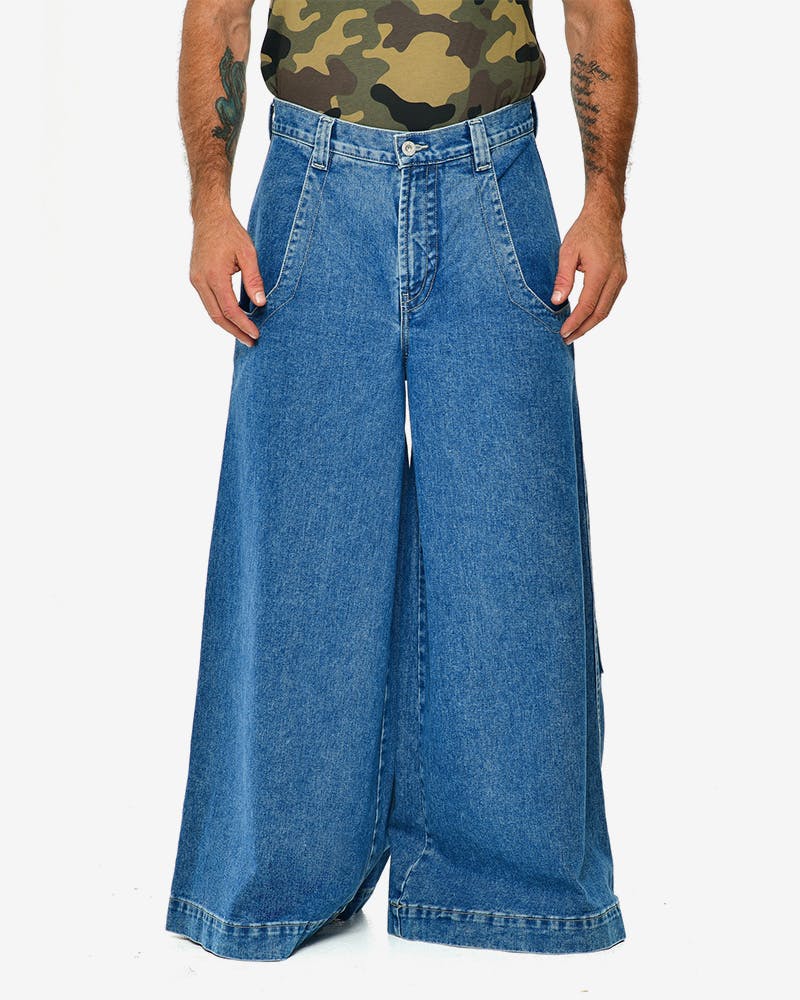
Many baggy jeans become wider gradually from the hip downward. JNCO’s most distinctive designs treated the complete leg as a large field of denim. The volume began high, continued through the knee and finished in an opening that could cover the shoe completely.
The extreme proportion changed how the wearer moved. Denim folded, swung and stacked instead of following the leg. The outline became almost architectural: a narrow upper body balanced above two heavy columns of fabric.
JNCO developed numerous named designs, from relatively restrained wide legs to models such as Mammoth, Rhino and Crime Scene. Some of the best-known heritage designs reached 50-inch leg openings, turning a normal garment measurement into a selling point.
Large back pockets gave the rear of the jeans equal visual weight. Embroidery, crowns, flames, animals and graffiti-influenced artwork made each design readable from a distance. The trousers did not need a visible label at the waistband to be recognised.
Wide legs remained substantial from thigh to hem rather than simply flaring near the ankle.
Huge back pockets created space for embroidered logos, cartoon symbols and graffiti-inspired graphics.
Long hems, dense denim and hidden footwear made the lower half of the outfit deliberately dominant.
The Subcultures
Skate, surf and rave communities carried JNCO outward
JNCO’s growth was not driven by denim alone. The brand attached itself to the communities that gave oversized clothing meaning.
Skateboarders valued loose fits because they offered freedom around the hip and knee, while the exaggerated outline matched skate culture’s resistance to polished adult fashion. The jeans worked naturally with oversized graphic T-shirts, hoodies, flannel shirts, beanies and substantial skate shoes.
Surf shops and youth-focused retailers helped carry the look beyond Los Angeles. Marketing executive Steven Sternberg reportedly tested the label with skate and surf buyers, using those communities as a bridge into the broader suburban teenage market.
Rave culture offered another home for the silhouette. Huge legs moved dramatically on dancefloors and worked with bright graphics, technical accessories and the deliberately excessive clothing associated with parts of the 1990s electronic scene.
For a wider history of the silhouette, read The History of Baggy Jeans. To explore current oversized denim, visit the Baggy Bliss collection.
How an unconventional Los Angeles denim label became a defining 1990s youth brand.
The brand is established
JNCO begins in Los Angeles, developing an identity informed by art, music, sports and unconventional street culture.
Wide-leg JNCOs enter the market
The label’s distinctive jeans begin reaching specialist retailers and teenage shoppers.
The silhouette goes mainstream
Skate, surf and mall distribution turn exaggerated denim into a national phenomenon.
Vintage demand revives the archive
Collectors and younger dressers rediscover original designs through resale and the wider return of Y2K proportions.
The Peak
JNCO became too visible to remain underground
By the late 1990s, JNCO had moved from specialist shops into major youth retailers and shopping centres. The same jeans that communicated subcultural difference were now available to teenagers across the United States and beyond.
The brand’s reported sales reached $186.9 million in 1998. That scale demonstrated the appetite for clothing that looked radically different from classic denim, but it also changed the meaning of wearing it.
JNCO appeared in school corridors, music culture, skate imagery, alternative retail and television-era youth fashion. Some schools attempted to restrict the jeans, often citing oversized pockets or excessively wide hems. Those rules strengthened their reputation as clothing adults did not understand.
The more dramatic styles became objects of competition. Width itself communicated commitment: a 20-inch opening looked relaxed, while the most extreme pairs turned the wearer into a moving wall of denim.
The paradox of success
JNCO became mainstream by selling rebellion
The label’s greatest commercial strength was also its cultural vulnerability. Once an underground-looking silhouette became available everywhere, teenagers began searching for the next shape that adults and the mass market had not yet absorbed.
The Reaction
Why the JNCO phenomenon faded
JNCO’s decline was rapid because its visual identity was so specific. When youth fashion changed direction, there was no subtle way for the most extreme pairs to blend into the next era.
Sales fell sharply after the 1998 peak. By 1999, reported revenue had dropped to approximately $100 million, and the company later closed its Los Angeles manufacturing facility as the original momentum weakened.
During the 2000s, denim moved through bootcut, distressed premium styles and increasingly narrow silhouettes. By the time skinny jeans became dominant, the huge JNCO leg represented the opposite of what mainstream fashion considered current.
The brand also faced the natural limit of escalation. Once jeans had reached extraordinarily wide openings, making them even larger no longer felt like a new idea. The proportion that created instant recognition became difficult to evolve without losing its identity.
Yet disappearance from mainstream retail preserved the jeans as physical records of their era. Original pairs survived in wardrobes, vintage shops and collections, waiting for a generation with no memory of their overexposure.
The Return
Vintage culture made extreme width feel new again
The return of JNCO developed alongside a broader rejection of the slim silhouettes that dominated much of the 2010s. As wide-leg trousers returned, younger wearers began searching for the most uncompromising examples of oversized denim.
Original JNCOs offered everything contemporary vintage culture values: recognisable construction, era-specific graphics, unusual named designs and a silhouette that could not be mistaken for a generic pair of jeans.
The brand went through several revival attempts, including a 2015 return and the reappearance of heritage designs such as the 50-inch Crime Scene. JNCO later re-established its own online presence with new versions shaped by the original archive.
Modern interest is not limited to exact replicas. JNCO’s influence is visible across super-wide denim, long inseams, oversized pockets, embroidered back graphics and trousers designed to pool around substantial trainers.
Original versus inspired
Not every super-baggy jean is a JNCO
JNCO describes a specific brand and design archive. Modern pairs may borrow the extreme width and low-slung proportion, but authentic vintage examples are identified through their labels, model names, embroidery, pocket construction and period-specific details.
What makes JNCO jeans different from ordinary baggy jeans?
Ordinary baggy jeans create space around the body. Classic JNCOs use that space as the main design feature.
The difference is clearest below the knee. A relaxed jean may taper slightly or fall straight, while an extreme JNCO design continues outward into a hem wide enough to hide the shoe. The fabric moves independently of the leg and creates a much heavier outline.
Branding is equally important. Oversized pockets, embroidery and model-specific graphics mean the jeans are designed to be recognised from behind as readily as from the front.
The classic skate combination
Pair super-wide denim with a loose graphic T-shirt, zip hoodie and substantial skate shoes. Keep the layers relaxed without making every item equally long.
The late-1990s hip-hop reference
Use an oversized jersey, heavyweight sweatshirt or roomy jacket above low-sitting denim, then add a cap or simple chain.
The early-2000s alternative look
Combine dark ultra-wide jeans with a fitted graphic top, studded belt, beanie and chunky footwear for a nu-metal or mall-goth influence.
The modern interpretation
Let the jeans remain the only extreme proportion. A shorter jacket or cleaner T-shirt gives the width space to look intentional rather than crowded.
How to wear super-baggy JNCO-style jeans today
The most important decision is length. The hem can stack over the shoe, but it should not drag so heavily that the denim becomes damaged immediately or makes walking difficult.
Choose footwear with enough presence to sit beneath the width. Chunky skate shoes, technical trainers and substantial boots support the silhouette more effectively than a narrow shoe that disappears completely.
Balance does not always mean wearing a tight top. A boxy T-shirt or shirt can work well, provided it ends high enough to preserve some structure between the torso and the huge leg.
A visible belt can control a low or oversized waist, while a cap, beanie or simple piece of jewellery adds a period reference without competing with the denim.
Find denim built around the same oversized attitude
Explore relaxed, wide and statement-making bottoms selected for the Dikdik Duds approach to baggy proportions.
Frequently asked questions
What are JNCO jeans?
JNCO jeans are wide-leg and often ultra-wide denim designs produced by the Los Angeles clothing brand JNCO. They became especially prominent during the 1990s through their exaggerated proportions, huge pockets and graphic embroidery.
What does JNCO stand for?
The meaning has never been confirmed consistently. “Judge None, Choose One” and “Journey of the Chosen Ones” are the two phrases most commonly linked to the name.
Who founded JNCO?
JNCO was founded in Los Angeles by brothers Haim Milo Revah and Jacques Yaakov Revah. The brand dates its establishment to 1985.
Why were JNCO jeans so wide?
The extreme width separated JNCO from conventional denim and connected the brand with youth cultures that valued loose movement, visual impact and rejection of traditional adult clothing.
How wide were the biggest JNCO jeans?
Some recognised heritage models reached 50-inch leg openings. Certain historical accounts describe even wider examples, but exact measurements varied by model, production period and how the opening was measured.
Were JNCO jeans worn by skateboarders?
Yes. Skateboarding was central to the brand’s rise and advertising. The loose silhouette matched the movement and anti-conventional styling associated with 1990s skate culture.
Why did JNCO jeans lose popularity?
The brand became heavily mainstream at the end of the 1990s, while fashion began moving towards narrower and less exaggerated denim. Its highly specific silhouette made the change particularly visible.
Are vintage JNCO jeans collectable?
Original pairs can be collectable, particularly unusual named models, extreme widths, strong embroidered graphics and examples in good condition. Value varies according to authenticity, rarity, size, wash and condition.
Archive notes
Research and further reading
This feature draws on JNCO’s official brand history and archived advertising, alongside historical reporting from Mental Floss, Highsnobiety and The Hundreds. These sources document the Revah brothers’ Los Angeles beginnings, the influence of East Los Angeles style and graffiti, JNCO’s skate and surf expansion, its late-1990s sales peak, the decline that followed and later heritage revivals.
The Archive Verdict
JNCO turned bagginess into a complete visual language.
The brand did not become memorable by making a slightly wider jean. It made denim so large that the garment changed the wearer’s outline, movement and relationship with the space around them.
Its rise depended on the collision of Los Angeles street culture, graffiti, skateboarding, surfing, rave style and youth retail. Its decline came when that collision became too familiar. Yet the very extremity that dated JNCO also preserved it. Decades later, the jeans still communicate the same refusal to disappear quietly into ordinary fashion.
Explore Baggy Bliss

