

Osaka, Japanese denim and the hand-painted gull that travelled around the world
The History of Evisu
How a small Osaka denim project built around vintage manufacturing, selvedge denim and a hand-painted back-pocket mark became one of the most recognisable names in 1990s and 2000s streetwear.

Evisu began with an obsession with the past. In 1991, a tiny denim operation in Osaka started making jeans slowly, using vintage-influenced methods and finishing each pair with a hand-painted mark across the back pockets.
That mark became the gull: two sweeping strokes that could identify a pair of jeans from across the street. Behind it was a deeper fascination with old denim — shuttle looms, selvedge edges, indigo, workwear construction and the way an unworn pair could become completely individual through years of fading.
During the following decade, Evisu travelled far beyond Japanese denim circles. The same jeans admired for their construction became status pieces within British streetwear, rave culture and early-2000s hip-hop. A label rooted in recreating the character of old American workwear had become an international symbol of premium Japanese denim.
Seven chapters tracing Evisu from Japan's vintage-denim obsession to an international streetwear icon and modern archive favourite.
The Context
Before Evisu: Japan rediscovered old American denim
Evisu makes more sense when placed inside Japan's wider fascination with vintage American clothing. During the decades before the brand appeared, collectors and clothing enthusiasts increasingly sought old jeans, work jackets, military garments, sweatshirts and other pieces of post-war American dress.
Denim became a particularly deep obsession. Vintage pairs revealed details that had gradually disappeared as jeans manufacturing became faster and more industrialised: irregular indigo, narrow selvedge fabric, different stitching weights, hidden rivets and the distinctive fading produced by older denim.
The objective was not simply to make something that looked old. Japanese denim makers became interested in understanding why old jeans looked and aged differently in the first place.
The wider movement
Evisu did not emerge from nowhere
The brand belonged to a wider Japanese movement that treated vintage American workwear as something worth studying in extraordinary detail. Evisu's importance came from combining that approach with a visual identity that could travel far beyond specialist denim circles.
The Beginning
A tiny Osaka operation with an unusually slow way of making jeans
Evisu was founded in Osaka in 1991. The name was inspired by Ebisu, the Japanese god traditionally associated with prosperity and good fortune.
The scale was initially tiny. According to Evisu's own history, only around fourteen pairs could be produced each day. Rather than hiding that lack of volume, the slow process became part of the appeal.
The jeans drew heavily from vintage denim construction. Narrow shuttle-loom fabric, selvedge edges, indigo and workwear details connected them with an earlier era of jeans manufacturing at a moment when mass-market denim production had largely moved elsewhere.
Evisu was therefore selling more than a cut of jeans. It was selling an approach to denim: one in which small construction details, fabric and ageing were worth noticing.
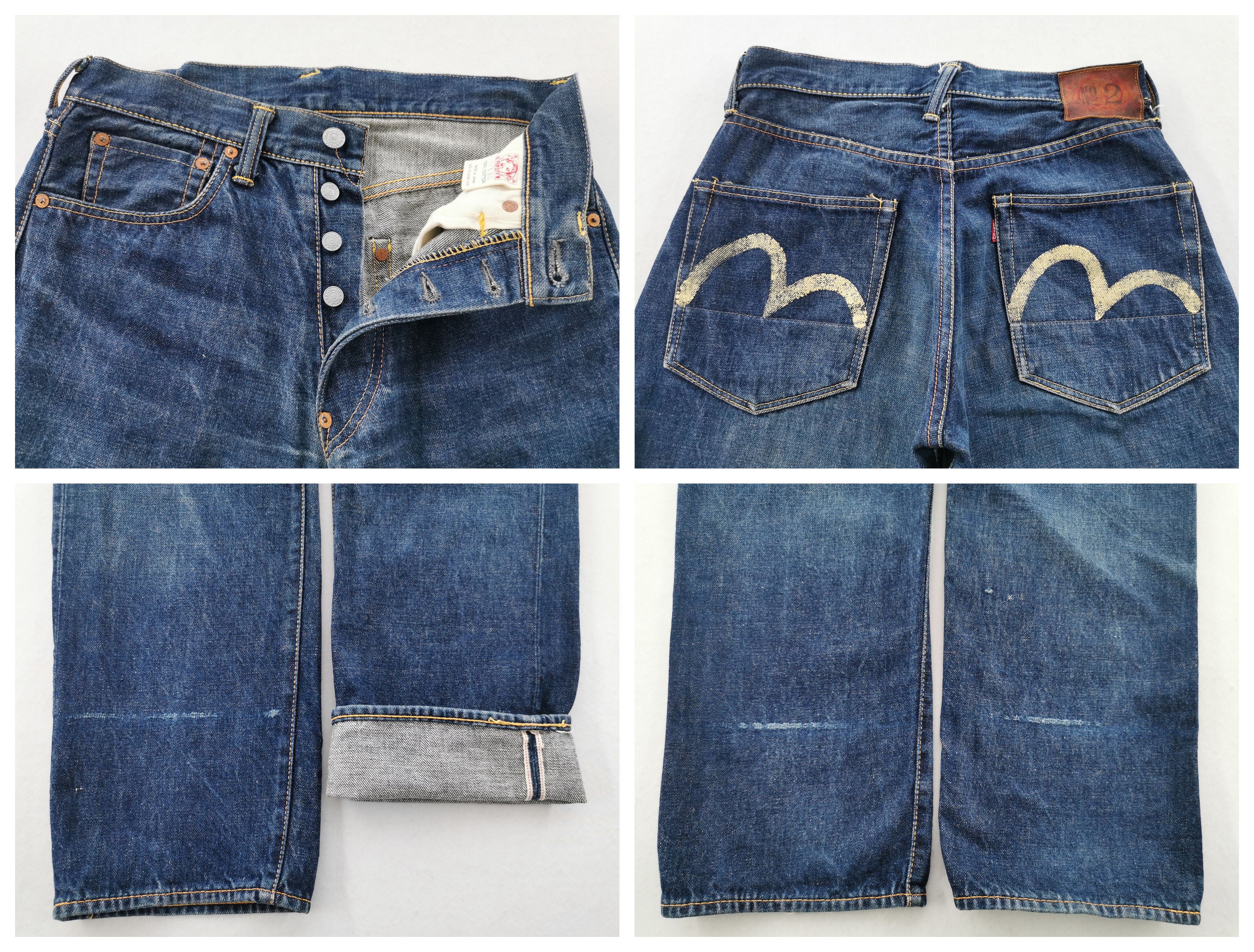
The combination of traditional denim construction and highly visible back-pocket artwork allowed Evisu to occupy two worlds at once: specialist denim and graphic streetwear. Vintage Evisu denim.
The Signature
The painted gull made the back pocket impossible to ignore
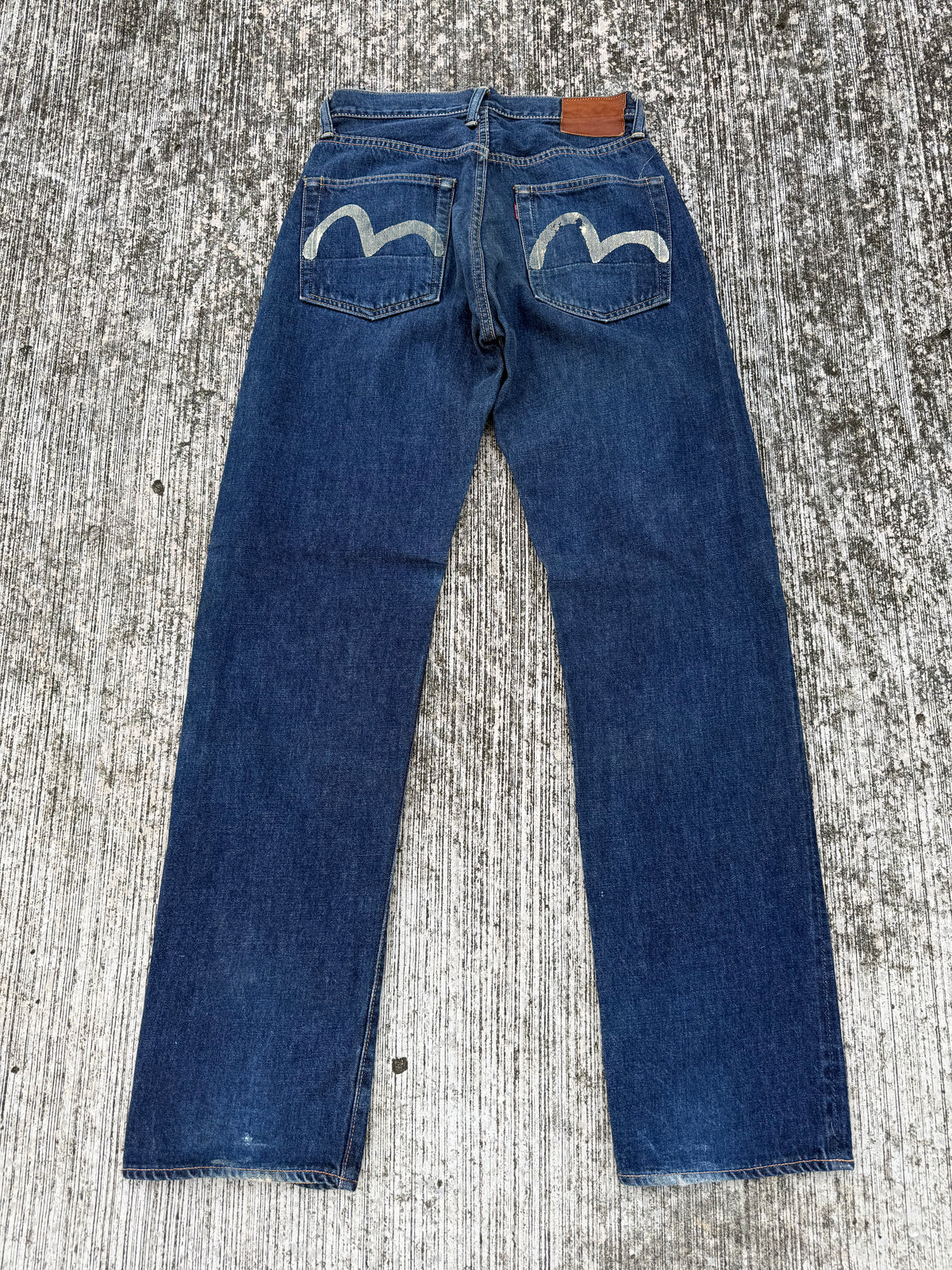
The detail that made Evisu internationally recognisable was remarkably simple. Two curved brush strokes were painted across the rear pockets, forming what became known as the Evisu gull or seagull.
Early examples were painted by hand. That mattered because the mark was not merely another sewn-on logo. Small variations in paint, placement and brushwork reinforced the idea that the jeans had passed through an individual production process.
The placement was equally effective. Denim brands had long used the rear pocket as an identifying surface through stitching, tabs and patches. Evisu enlarged that idea until the branding became one of the most visible parts of the entire garment.
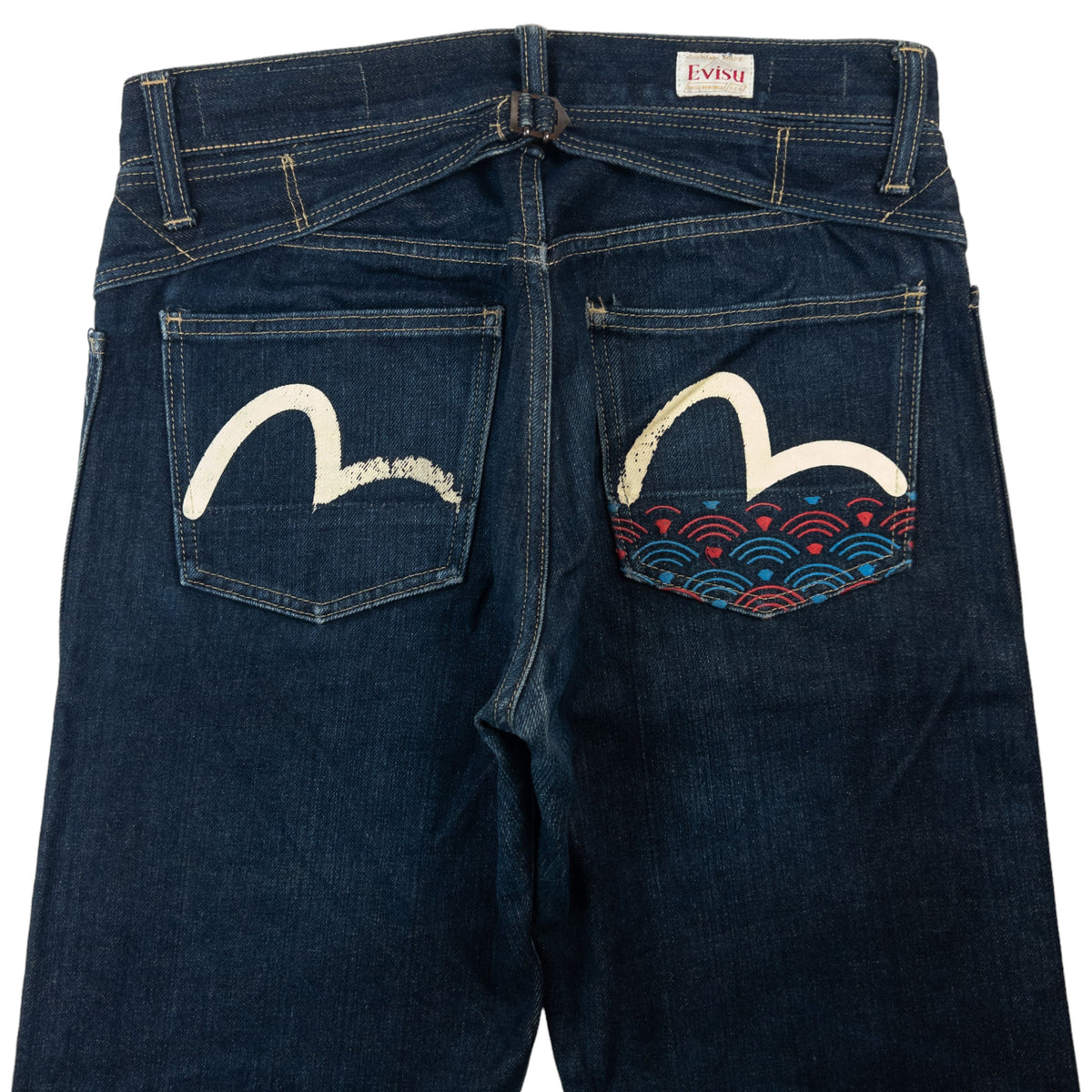
As the brand developed, the gull appeared in painted, printed and embroidered forms, but the basic gesture remained instantly recognisable.
A sweeping back-pocket mark created an identity that could be recognised without reading a label.
Narrow shuttle-loom fabric connected the jeans with the construction methods admired in older workwear.
Paint, stitching, hardware and fabric encouraged the wearer to look closely at how the jeans had been made.
The Craft
Japanese denim became part of the attraction
The gull attracted attention, but the denim gave enthusiasts a reason to look closer. Evisu built its reputation around details associated with traditional jeans manufacturing and vintage American workwear.
The company's technical material describes denim woven on narrow shuttle looms, producing the finished selvedge edge visible when the inside seam is turned up. Evisu also emphasises indigo dyeing, varied thread weights and colours, specialised hardware and construction details inspired by older workwear.
These characteristics mattered most after the jeans had been worn. Raw or dark indigo denim does not remain visually static. Creases around the lap and knees gradually lighten, pocket outlines become visible and the hem develops wear according to the footwear beneath it.
A heavily worn pair therefore becomes different from the pair that originally left the shop. The owner effectively finishes the ageing process through everyday use.
How a small Osaka denim project developed into an internationally recognised streetwear name.
Evisu begins in Osaka
Small-scale denim production and hand-painted gulls establish the foundations of the brand.
Japanese denim gains attention
Evisu develops an audience attracted to selvedge construction, indigo and vintage-inspired manufacturing.
The gull travels globally
International streetwear, music and premium-denim culture turn Evisu into a highly visible status label.
The archive returns
Renewed interest in Y2K clothing, wide denim and Japanese streetwear brings older Evisu back into focus.
The Expansion
The gull moved from denim circles into global streetwear
Evisu's breakthrough outside Japan changed how the jeans could be read. To a denim enthusiast, the attraction might have been shuttle looms, indigo and construction. To someone encountering the brand through streetwear, the huge gull could matter just as much.
That combination proved unusually powerful. The jeans could carry the credibility of specialist Japanese denim while still functioning as a highly visible status piece.
By the early 2000s, premium and heavily branded denim had become increasingly important within hip-hop style. Oversized jeans, large back-pocket designs, tall T-shirts, trainers and visible designer branding created a silhouette in which the rear of the jean could communicate as much as the front.
Evisu fitted naturally into that environment. The gull did not need explanation. It was large, graphic and readable from a distance.
One pair of jeans could speak to completely different audiences
Evisu's unusual strength was that the same garment could be appreciated for almost opposite reasons. One wearer might care about how the denim was woven and how the indigo would fade. Another might simply want the biggest and most recognisable gull possible.
The distinction became increasingly visible as Evisu expanded its graphics. Some pieces retained restrained painted pocket marks, while others used oversized Daicock motifs, embroidery, colour and artwork that extended far beyond the pocket itself.
Japanese denim enthusiasts
For denim-focused buyers, selvedge construction, indigo, stitching and the way a pair developed through wear could matter more than conspicuous branding.
British street and rave culture
Evisu gained a strong cultural presence in Britain, where expensive Japanese denim could sit alongside trainers, sportswear and other highly recognisable labels within late-1990s and 2000s street style.
Early-2000s hip-hop
The large gull suited an era of designer denim, oversized silhouettes and visible branding. Evisu became part of a broader premium-jeans vocabulary within hip-hop fashion.
Collectors
Older pairs could be approached almost as denim records, with labels, paint, construction, fading and production details used to distinguish different periods and lines.
The Shift
Fashion moved away from the silhouette that helped make Evisu famous
The denim landscape changed dramatically after the early 2000s. Slimmer jeans became increasingly dominant, while the oversized designer-denim uniform associated with the previous decade began to look visibly tied to its era.
That did not mean Evisu disappeared. The company continued to develop internationally, expand beyond denim and work across collaborations and new collections. But the cultural meaning of an enormous pair of branded jeans had changed.
For vintage culture, this period proved useful. Clothing that falls out of mainstream fashion has time to become historical. Older Evisu pairs moved into resale, vintage shops and private collections, where differences in age, construction, graphics and fading became part of their appeal.
Why the quiet period matters
A garment often has to become unfashionable before it can become vintage
Once the early-2000s premium-denim look stopped being current, original Evisu could be viewed as evidence of a particular period rather than simply an expensive pair of contemporary jeans.
The Return
Y2K fashion brought the gull back into focus
The return of wider trousers and early-2000s styling changed the way older Evisu looked again. Shapes that had seemed excessive during the slim-denim years suddenly made sense beside oversized jackets, graphic tops, technical trainers and skate-influenced footwear.
Vintage Evisu offered something newer Y2K-inspired clothing could only reproduce: genuine period construction and natural ageing. Paint could be cracked or partially worn away. Indigo could have faded around the body. Hems could carry years of stacking and abrasion.
The brand itself also continued to draw on its archive while moving through collaborations and new interpretations. Evisu's official history records projects with names including Puma, Champion, New Era and Palace, demonstrating how far the identity travelled from its small-scale Osaka beginnings.
Original versus revival
Not every pair with a gull tells the same story
Evisu has produced numerous lines, fits, graphics and interpretations over more than three decades. When buying vintage, assess the entire garment rather than assuming that one recognisable back-pocket mark establishes its age or exact production history.
What should you look for when buying vintage Evisu?
The first rule is not to authenticate a pair from the gull alone. Evisu has used different labels, patches, denim, graphics and construction across markets and periods, while the visibility of the brand has also made it a target for imitation.
Look at the garment as a complete object. Compare the claimed period with its labels, hardware, pocket construction, stitching and fabric. If a seller makes a very specific age or model claim, ask for clear photographs of those details.
When looking at vintage Evisu, check:
- The full front and rear of the jeans rather than judging from the gull alone.
- The waistband patch and internal labels.
- The pocket shape, stitching and application of the gull.
- The button and rivet details.
- The selvedge edge where relevant to the claimed model.
- The actual waist, rise, thigh, inside-leg and hem measurements.
- Whether the jeans have been shortened, tapered or otherwise altered.
- Whether fading and wear are consistent with the condition described.
For a fuller guide to assessing older denim before buying, read The Ultimate Guide to Buying Vintage Jeans.
Why worn Evisu can look better than pristine Evisu
The most interesting vintage examples often show the tension between the painted graphic and the ageing denim underneath it. Dark indigo becomes pale around high-wear areas while the gull cracks, fades or disappears in sections.
That wear makes two originally identical pairs increasingly different. One might develop strong lap fades and a nearly complete gull; another might remain dark while most of the paint has worn away.
It is exactly the kind of individuality that the early fascination with vintage denim celebrated in the first place.
Do not buy purely for the gull
Look at the complete garment, construction and labels rather than treating one graphic detail as proof of age or authenticity.
Do not assume the tagged size
Older denim may have shrunk, stretched or been altered. Use actual garment measurements before buying.
Do not treat all Evisu as one fit
The brand has produced numerous silhouettes. Check the rise, thigh, leg shape and hem rather than buying from the name alone.
Do not mistake damage for desirable ageing
Fading and worn paint can add character, but weakened crotches, torn hems and failing seams still need to be judged practically.
Explore denim built around relaxed proportions
Discover wide, loose and statement-making bottoms selected around the Dikdik Duds approach to baggy silhouettes.
Frequently asked questions
When was Evisu founded?
Evisu was founded in Osaka, Japan, in 1991. The brand developed from a small-scale denim project into an internationally recognised Japanese denim and streetwear label.
Where does the name Evisu come from?
The name is derived from Ebisu, the Japanese god associated with prosperity and good fortune.
Why does Evisu use the seagull logo?
The curved back-pocket mark became Evisu's signature during its early production. Original pairs were hand-painted, and the motif later appeared in painted, printed and embroidered forms.
Were early Evisu jeans painted by hand?
Yes. Evisu states that its early jeans were individually hand-painted with the now-famous seagull mark, with initial production limited to roughly fourteen pairs per day.
What is Evisu selvedge denim?
Selvedge denim is woven on narrower shuttle looms that create a finished edge along the fabric. Evisu has used this construction as part of its vintage-influenced approach to denim manufacturing.
Why was Evisu popular in the 2000s?
Evisu combined premium Japanese denim with extremely recognisable branding at a time when designer jeans, oversized silhouettes and prominent back-pocket graphics were highly visible within streetwear and hip-hop.
Is vintage Evisu popular again?
Renewed interest in wider denim, Japanese streetwear and late-1990s and Y2K clothing has brought older Evisu pieces back into vintage and resale culture.
How can you tell whether Evisu jeans are vintage?
Assess the entire garment rather than relying on the gull alone. Labels, patches, buttons, rivets, stitching, denim construction and other period-specific details should support any claimed age or model.
Archive notes
Research and further reading
This feature draws on Evisu's official brand history and technical denim material, including its 1991 Osaka origins, early small-scale production, hand-painted seagull, selvedge construction and later international development. Wider cultural context draws on historical coverage of Evisu's place within early-2000s premium denim, hip-hop and streetwear.
The Archive Verdict
Evisu made craftsmanship impossible to separate from identity.
The brand began by looking backwards. Its fascination with vintage denim, shuttle looms, indigo and old workwear construction belonged to a Japanese movement that treated apparently ordinary jeans as objects worth studying in extraordinary detail.
Then Evisu added something that made that obsession visible. The painted gull transformed the rear pocket into a signature, allowing a pair of technically detailed Japanese jeans to communicate instantly within streetwear, rave culture and hip-hop.
That contradiction is what keeps Evisu interesting. It can be quiet selvedge denim or enormous graphic branding; a study of old American workwear or an unmistakable artefact of Y2K street style. More than three decades after the first pairs were painted in Osaka, two curved marks across the back pockets can still identify the jeans before the label is ever seen.
Explore Baggy Bliss →

